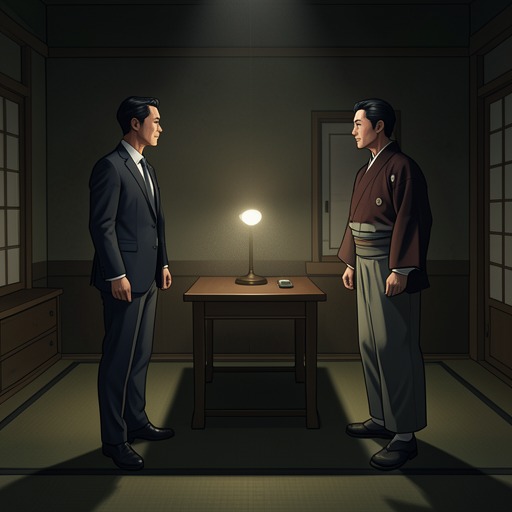
Bond’s mission to assassinate Dr. Guntram Shatterhand
You Only Live TwiceBond’s mission to assassinate Dr. Guntram Shatterhand is the point at which Tiger Tanaka’s alarming account of a foreign collector becomes a direct assignment for James Bond. Shatterhand is presented as a legally admitted horticulturalist whose supposedly scientific project has been associated with more than five hundred Japanese deaths in under six months. Tiger makes confronting him a test of Bond’s fitness to receive intelligence for Britain: Bond must enter the Death Castle and slay the Dragon within, while the Prime Minister’s decision to share the material remains conditional on his success.
The Threat Behind the Assignment
Tiger introduces Shatterhand as an exceptional and malevolent figure among foreigners living in Japan. Most, he says, are harmless eccentrics; the man who entered the country in January is different, a fiend whose ingenuity and grasp of Japanese psychology distinguish him from an ordinary criminal. Tiger’s description is deliberately difficult to reduce to a simple accusation. When James Bond asks whether Shatterhand kills people, Tiger corrects him: Shatterhand persuades or entices people to kill themselves—or, more precisely, provides what Tiger calls an easy and attractive opportunity for them to do so. The distinction makes the danger less direct, not less grave. Tiger gives the scale of the crisis as a tally of more than five hundred Japanese in just under six months.
The account initially rests on Tiger’s description rather than on a meeting between Bond and Shatterhand. Shatterhand is physically absent from the conversation, and Bond’s understanding of him is formed through Tiger’s claims and the facts Tiger presents. That mediated introduction gives the mission its defining imbalance: Bond is asked to act against a target whose intentions and methods have been explained to him, but whom he has not yet encountered.
A Respectable Identity and a Difficult Case
Tiger says Shatterhand entered Japan legally, accompanied by Frau Emmy Shatterhand, born de Bedon. The couple carried Swiss passports. Shatterhand described himself as a horticulturalist and botanist specializing in subtropical species, and brought references from the Jardin des Plantes in Paris, Kew Gardens, and other authorities. Tiger characterizes those references as nebulous, even though they helped establish the appearance of professional legitimacy.
After contacting Japanese authorities and experts in the Ministry of Agriculture, Shatterhand offered to spend one million pounds establishing an exotic garden or park in Japan and filling it with a priceless collection. The proposal gives the alleged killer a public identity that contrasts sharply with Tiger’s account of the deaths: a foreign specialist, equipped with credentials and substantial private funds, pursuing an ambitious horticultural project. Tiger does not describe a straightforward case in which arrest and punishment would settle the matter. When Bond asks why the authorities do not arrest and hang Shatterhand, Tiger replies that it is not so simple. The gap between the legal appearance of the project and its human consequences is the problem that precedes the assignment.
From Intelligence Request to Personal Test
The mission’s immediate political setting is an intelligence request. Bond had previously told Tiger that, in exchange for MAGIC 44, he would undertake personal services on Tiger’s behalf. Bond clarifies that he had meant a personal commitment, not that he possessed official authority to promise such services. Tiger accepts that distinction as sufficient: he has taken Bond at his word and sought an audience with the Prime Minister. The matter, Tiger says, is a state secret known to the Prime Minister, Tiger, and Bond.
Tiger also makes the mission a judgment on Britain’s capacity to handle valuable intelligence. He repeats a severe assessment of Britain’s diminished power and asks what Japan would gain by supplying material to a country he portrays as weakened. Bond reacts angrily, defending the British people while conceding the effects of two world wars, the politics of the Welfare State, and the rapid liberation of the colonies. His response ranges from Everest and international sport to Nobel Prizes. Tiger then reveals that the provocation was intentional: he wanted to see whether Bond’s famous English stoicism would break under pressure. He tells Bond that he had addressed similar arguments to the Prime Minister, who authorized a test of the British agent.
The intelligence is therefore not simply a prize Bond can obtain by asking for it. Tiger frames its release as conditional: if Bond succeeds, the Prime Minister will accept that an elite still exists in Britain and that the material will be safe in British hands; if Bond fails, Japan will politely reject the request. The test ties Bond’s individual performance to a judgment about the recipient country and gives his mission diplomatic consequences beyond the fate of Shatterhand.
The Death Castle Test
Bond initially tries to defer the discussion. He is tired, doubts that Tiger’s story will reach a conclusion that evening, and offers to give advice the next day. Tiger stops him with an order to sit down and tells him to leave the following day on the twelve-twenty train from Tokyo main station. Bond is to travel to Fukuoka, on Kyushu, will not return to his hotel, and will not see Dikko. From that point, Tiger says, Bond is under his personal orders.
Bond is startled by the sudden change from conversation to command. Tiger justifies it by returning to the earlier promise Bond made in connection with MAGIC 44. Bond objects that he had offered a personal undertaking rather than claiming authority to act for his service; Tiger considers that distinction no obstacle. Having established the secrecy and political authorization for the test, Tiger states its terms: Bond is to enter the Death Castle and slay the Dragon within. The metaphor supplies the mission’s dramatic shape, while the evidence about Shatterhand identifies the enemy behind it. Bond’s task is thus framed not as another request for information or advice, but as a direct confrontation.
Significance and Limits of the Mission
The assignment binds together three problems that Tiger has first presented separately: Shatterhand’s lethal enterprise, Japan’s reluctance to treat the case as a simple arrest, and Britain’s request for intelligence. Tiger converts the first into Bond’s personal objective and makes the second the basis for a test whose result governs the third. Bond’s promise to Tiger provides the personal leverage; the Prime Minister’s approval makes the stakes governmental; and the Death Castle gives the test a concrete destination and a declared enemy.
At this point, the mission is an order and a conditional test, not a completed assassination. The exchange establishes Bond’s destination and objective but does not yet show him confronting Shatterhand or reveal the outcome of the attempt. Its immediate reversal is from Bond’s weary expectation that Tiger is merely recounting a disturbing case to the realization that the story has been a prelude to placing Bond under Tiger’s personal command.